
Exhaust Modification Impact Estimator
Analysis Result
Select your engine and modification to see the estimated impact.
Quick Takeaways: The Basics
- What it is: An exhaust system where the restrictive parts (mufflers and resonators) are removed.
- The sound: Significantly louder, raw, and deeper tone.
- The gain: Potential for slight horsepower increases by reducing backpressure.
- The downside: Legal issues, noise complaints, and potentially worse low-end torque.
Breaking Down the Straight Pipe
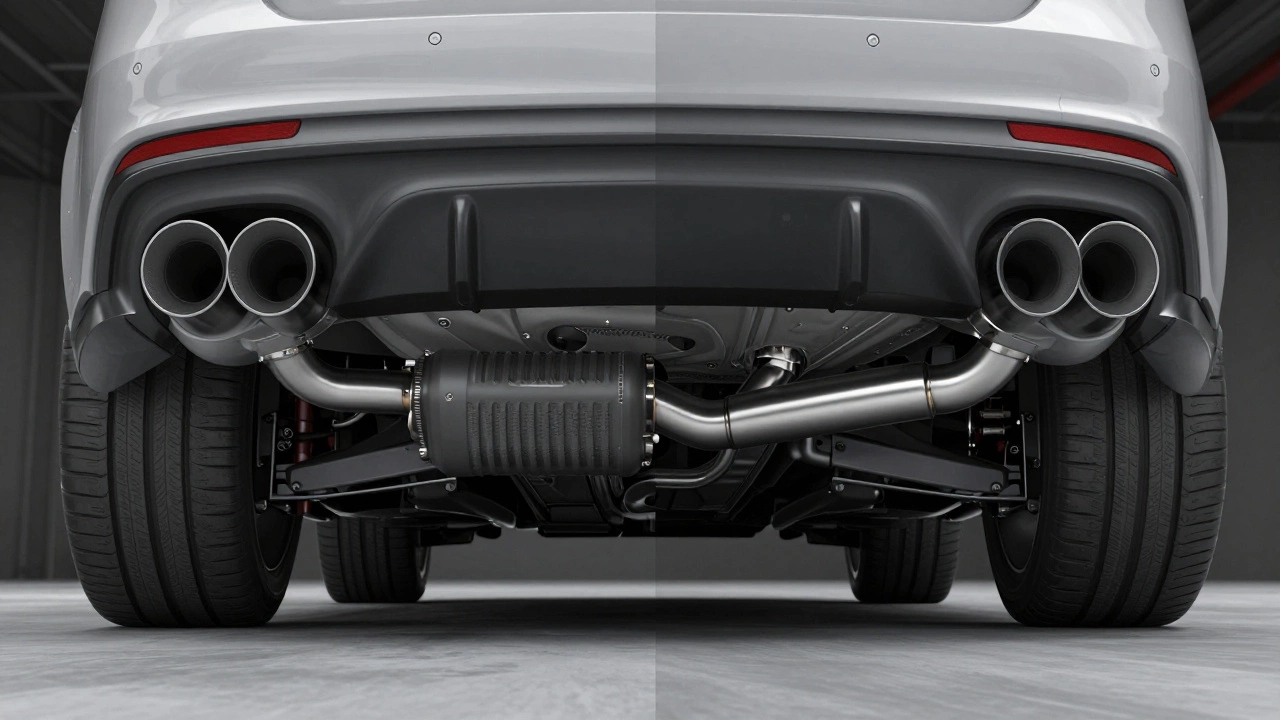
To understand a straight piped exhaust is an exhaust configuration where the exhaust gases flow from the engine to the tailpipe with minimal restriction, omitting the muffler and resonator, you first have to look at how a stock car works. A factory system is designed to be quiet and efficient for the average driver. It uses a Muffler, which is essentially a series of chambers and perforated tubes designed to cancel out sound waves. Then there's the resonator, which cleans up the tone to prevent droning.
When someone says they've "straight piped" their car, they've basically stripped all that out. They replace the complex factory piping with a simple, direct tube. It's the automotive equivalent of taking the silencer off a gun. You're leaving the gases to exit the engine as quickly as possible, which is why the sound is so violent and unfiltered.
How It Actually Affects Performance
There is a common belief that removing everything makes a car faster. In the world of Performance Upgrades, the truth is a bit more nuanced. The primary goal here is reducing backpressure. Backpressure is the resistance the engine faces when trying to push exhaust gases out of the cylinder. By removing the muffler, you allow the engine to "breathe" better at high RPMs.
In a high-performance turbocharged engine, reducing restriction can lead to a measurable increase in horsepower. For example, a tuned 2JZ or an RB26 engine might see a noticeable jump in top-end power because the turbo can spool more efficiently without fighting a restrictive muffler. However, for a standard naturally aspirated commuter car, the gains are often negligible-maybe 2 to 5 horsepower-which you'll likely never feel while driving to the grocery store.
There is a catch, though. Some engines rely on a specific amount of backpressure to maintain low-end torque. If you go too "straight," you might actually find that your car feels sluggish when pulling away from a stoplight. This is why professional racers tune their exhaust diameter specifically to the engine's displacement.
| Feature | Stock Exhaust | Straight Pipe |
|---|---|---|
| Noise Level | Quiet / Muffled | Extremely Loud |
| Backpressure | High (Controlled) | Very Low |
| Low-End Torque | Optimized for City Driving | Potentially Reduced |
| Legal Status | Compliant | Often Illegal |
| Cost | Included | Cheap to implement |
The Noise Factor: More Than Just Volume
The most obvious change is the sound. Without a muffler, you hear the actual combustion process and the mechanical movement of the valves. This results in a raw, metallic sound. But it's not just about the volume; it's about "drone." Drone is that humming, vibrating sound that happens at a specific cruise speed (usually around 2,000 to 3,000 RPM).
In a straight-piped car, the drone can be unbearable. Imagine sitting in a metal tube with a loud speaker vibrating against your spine for a two-hour highway trip. This is why many enthusiasts eventually move toward a Cat-Back Exhaust system, which keeps a small muffler or a high-flow resonator to kill the drone while keeping the aggressive tone.
The Legal and Environmental Minefield
Here is where things get tricky. In most places, straight piping is a fast track to a ticket. Law enforcement and environmental agencies have strict rules about decibel levels and emissions. There is a massive difference between a "muffler delete" and a "test pipe" (removing the catalytic converter).
If you remove the Catalytic Converter, you are no longer just dealing with noise; you are dealing with federal or state emissions laws. The converter's job is to turn toxic gases into less harmful substances. Removing it makes the car smell like a 1970s tractor and is a serious offense in many jurisdictions. Even if you keep the converter but ditch the muffler, you're likely exceeding the legal decibel limit, which can lead to your car being deemed "unroadworthy."
In many cities, noise complaints are the primary way police find modified cars. A straight-piped car is essentially a beacon that tells every cop within five blocks that you've modified your vehicle. If you're planning this mod, consider a "cutoff" or a valve system that allows you to switch between quiet and loud modes at the flip of a switch.

Common Pitfalls and Pro Tips
If you're determined to go this route, don't just hack off your muffler with a reciprocating saw and call it a day. There are a few things to keep in mind to avoid ruining your driving experience:
- Check your hangers: Removing a heavy muffler can leave your exhaust piping unsupported, leading to rattling or, in worst-case scenarios, the pipe falling off under the car.
- Mind the diameter: Going too wide with your piping (e.g., putting a 3-inch pipe on a small 4-cylinder engine) will kill your exhaust velocity and destroy your low-end power.
- Consider a resonator: If the sound is too "raspy" (sounding like a swarm of bees), adding a small Resonator can smooth out the tone without significantly increasing backpressure.
- Tuning is key: If you've removed a major restriction, your engine's air-fuel ratio might be slightly off. A quick remap of the ECU can help optimize the new flow.
Is it Worth It?
For most people, the answer is probably no. The tiny bit of power you gain is overshadowed by the loss of comfort and the risk of legal trouble. However, for a dedicated track car or a show vehicle, the visceral experience of a straight pipe is unmatched. It makes the car feel more alive and mechanical.
If you want the sound without the headache, look into high-flow mufflers. They provide a similar "deep" growl but keep the noise within a range that won't get you pulled over every other weekend. The goal should always be a balance between performance, sound quality, and usability.
Will a straight pipe damage my engine?
Generally, no. Removing a muffler doesn't hurt the internal components of the engine. However, if you remove the catalytic converter, you might trigger a Check Engine Light (CEL) because the O2 sensors will detect that the emissions are out of spec. While it won't "break" the engine, it can cause the computer to run the engine in a less efficient mode.
Does a straight pipe increase MPG?
In theory, reducing backpressure makes the engine more efficient, which could slightly improve fuel economy. In reality, the difference is so small it's usually unnoticeable. Furthermore, most people who straight pipe their cars tend to drive them more aggressively, which completely cancels out any theoretical MPG gains.
Can I just remove the muffler and keep the rest stock?
Yes, this is commonly called a "muffler delete." It's the easiest way to get a louder sound. You simply replace the muffler section of the pipe with a straight piece of tubing. Just be aware that this is where the most "drone" occurs, especially on highway cruises.
Is a straight pipe louder than a performance exhaust?
Almost always. A performance exhaust (like a cat-back system) is designed to increase flow while still using some level of sound dampening. A straight pipe removes all dampening, resulting in the maximum possible volume for that specific engine.
Will my car fail inspection with a straight pipe?
In most regions, yes. Inspection stations check for the presence of mufflers and catalytic converters, as well as noise levels. If you've removed these, you'll likely fail the emissions or safety portion of the test.