Custom Exhaust Cost Estimator
Custom Exhaust Cost Estimator
Estimate costs for your custom exhaust system based on Australian 2026 pricing. Select components and materials to see your total.
Your Estimated Cost
When you hear the deep rumble of a custom exhaust on a late-model muscle car or a modified Japanese import, you’re not just hearing sound-you’re hearing craftsmanship. But can any shop make a custom exhaust? Or is this something only high-end tuning garages with fancy equipment can handle? The answer isn’t simple, and it’s not just about having a welder and a pipe bender.
Not Every Shop Can Do It-Here’s Why
Many local mechanics will tell you they can "do exhausts." But there’s a big difference between replacing a muffler and building a custom exhaust from scratch. A custom exhaust isn’t just a longer or louder pipe. It’s a precision-engineered system that affects engine performance, sound, weight, and even emissions. If the shop doesn’t understand airflow dynamics, header design, or backpressure curves, they’re just guessing.
Think of it like this: you wouldn’t ask a tire shop to build you a custom suspension. Same logic applies here. Building a custom exhaust requires knowledge of metallurgy, thermal expansion, resonance tuning, and exhaust gas velocity. Most shops that offer "custom" exhausts are just swapping out stock parts with aftermarket ones. That’s not custom. That’s replacement.
What Makes a Real Custom Exhaust?
A true custom exhaust is built to your car’s exact specs. That means:
- Headers are shaped to match your engine’s port layout, not pulled from a catalog
- Pipe diameter is calculated based on engine displacement, RPM range, and turbo setup (if any)
- Flow path avoids sharp bends that create turbulence
- Muffler type and chamber design are chosen for your desired sound profile-not just "loud" or "quiet"
- Mounting points are engineered to reduce vibration and prevent stress cracks
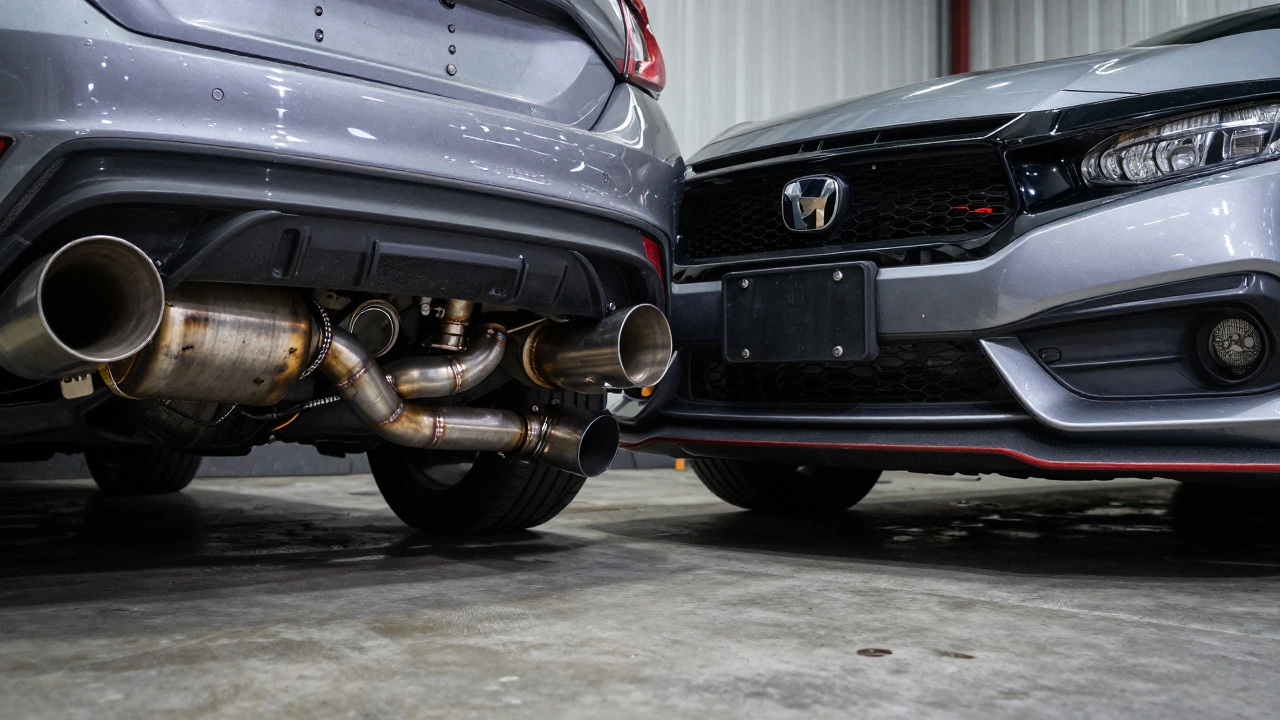
For example, a 2.0L turbocharged Honda Civic needs a completely different exhaust layout than a 5.0L V8 Ford Mustang. The former needs high-velocity, short-path piping to spool the turbo quickly. The latter needs larger-diameter pipes to handle high-volume, low-RPM flow. One size does not fit all.
What Tools and Skills Are Needed?
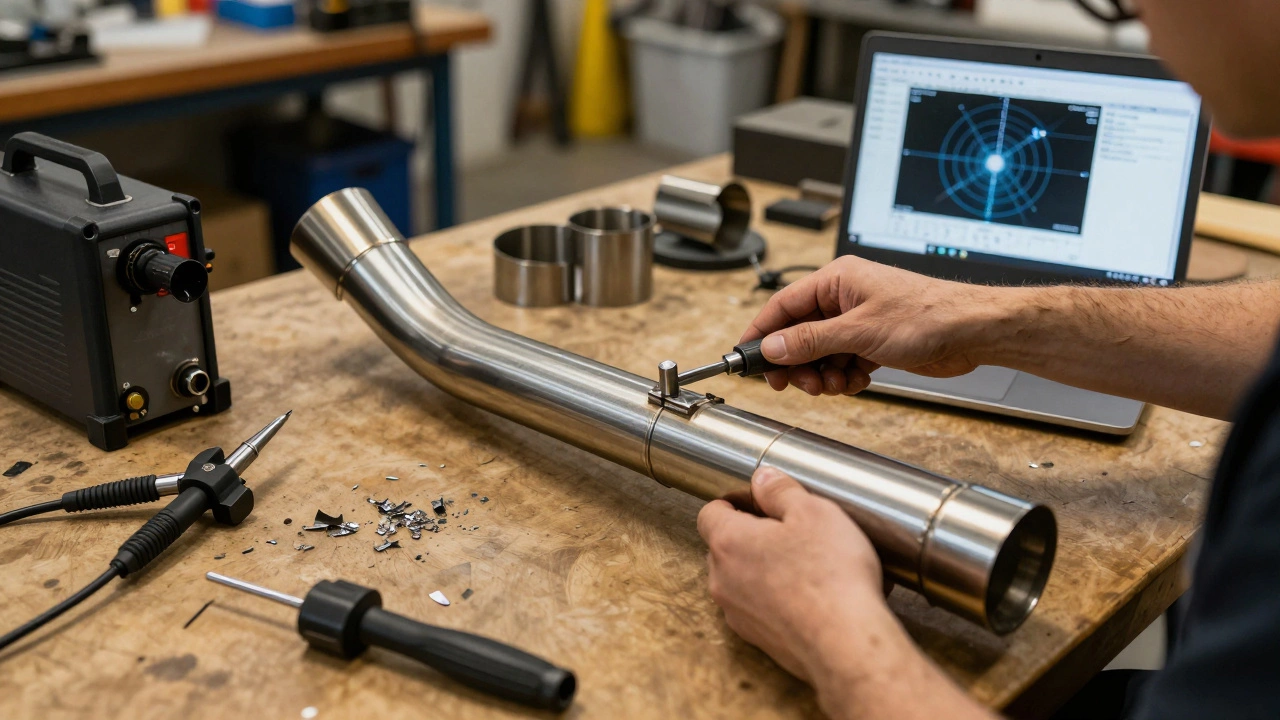
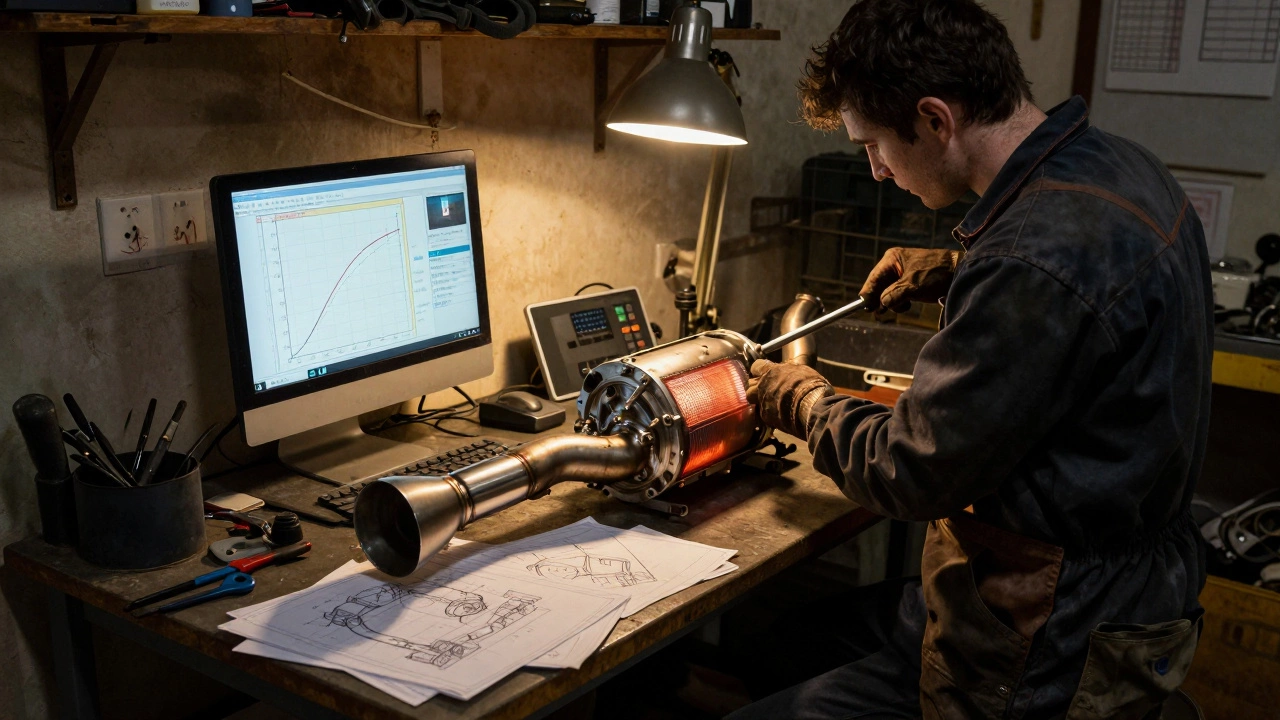
Building a custom exhaust isn’t just about having tools-it’s about knowing how to use them. Here’s what a real custom exhaust shop needs:
- Tube bender with mandrel-to bend stainless steel or titanium without crushing the pipe
- Plasma cutter or band saw-for precise cuts
- Welding station with TIG capability-TIG welding gives clean, strong, corrosion-resistant joints
- Exhaust simulation software-like PipeMax or Dynojet, to model flow before cutting metal
- Experience with dyno testing-to verify power gains and tune the system
Most shops don’t have all this. Some have one or two tools and call themselves "custom." But without the full toolkit and the engineering knowledge behind it, you’re getting a modified exhaust-not a custom one.
What to Look for in a Shop
If you’re serious about a custom exhaust, here’s how to find a shop that can actually deliver:
- Ask to see past builds-not photos from Instagram. Ask for videos of dyno runs with before-and-after numbers.
- Check their materials-real custom shops use 304 stainless steel or titanium. Avoid shops that use aluminized steel-it rusts in under a year.
- Ask about design process-if they say "we just copy what’s popular," walk away.
- Look for dyno results-a shop that can show you 15-25 hp gains on a specific car model knows what they’re doing.
- Ask about warranty-a confident shop offers a 2-5 year warranty on welds and material.
Some shops in Brisbane, like those in the industrial zones around Murarrie or Eight Mile Plains, specialize in this. They’ve built systems for everything from Nissan Skyline GT-Rs to Ford Falcons. But they don’t advertise on Facebook. You find them through word of mouth, track days, or car clubs.
What Happens If You Go Cheap?
Skipping the real custom shop and going with a "quick fit" exhaust can cost you more than money.
- Power loss-poorly designed pipes create turbulence, killing torque
- Excessive noise-if the muffler isn’t tuned right, you’ll get a droning sound that’s unbearable on highways
- Heat damage-wrong pipe routing can melt wiring, fuel lines, or even the floorpan
- Failed emissions-in places like Queensland, where emissions testing still applies to modified cars, a poorly designed system can trigger a fail
- Resale value crash-a sloppy custom exhaust turns buyers away. A clean, well-documented one adds value.
I’ve seen a $30,000 Toyota Supra lose $10,000 in value because the previous owner went to a "budget exhaust shop" and ended up with a system that rattled, overheated, and smelled like burnt plastic. It wasn’t loud-it was just broken.
How Much Does a Real Custom Exhaust Cost?
There’s no magic number. But here’s what you can expect in Australia in 2026:
| Component | Material | Estimated Cost | Labor Time |
|---|---|---|---|
| Headers | 304 Stainless Steel | $800-$1,500 | 8-12 hours |
| Mid-pipe | 304 Stainless Steel | $400-$700 | 4-6 hours |
| Muffler | Performance Chamber (Custom) | $300-$900 | 2-4 hours |
| Resonators & Tips | 304 Stainless Steel | $200-$500 | 2 hours |
| Total | $1,700-$3,600 | 16-24 hours |
That’s for a full system. If you’re just upgrading the rear section, you might pay $700-$1,200. But remember: if the shop quotes you under $1,000 for a full custom system, they’re likely using off-the-shelf parts and calling it "custom."
Can a Regular Auto Shop Do It?
Almost never. Most general auto shops don’t have the expertise, tools, or time. They’re trained to replace parts, not design them. You might get lucky if you find a shop that specializes in race cars or drift builds. But even then, ask for proof.
There are exceptions. Some older shops that have been around since the 1990s still build custom exhausts by hand. They don’t have websites. They don’t post on TikTok. But if you show up with a car and say, "I want this to sound like a V8 but still pass emissions," they’ll know exactly what you mean.
What’s the Alternative?
If you can’t find a true custom shop, consider a semi-custom system. These are pre-designed kits that allow for some customization-like choosing muffler type, tip style, or pipe diameter. Brands like Borla, Akrapovič, and Invidia offer semi-custom options that fit specific models with minimal fabrication.
It’s not as good as a full custom build, but it’s safer than a $400 eBay special. And in many cases, it’s enough to get you 15-20 hp and a meaner sound without the risk.
Final Verdict
Can a shop make a custom exhaust? Yes-but only if they have the right tools, the right knowledge, and the right track record. Most can’t. And if they say they can without showing you data, dyno results, or past builds, they’re selling you a myth.
The best custom exhausts aren’t loud. They’re efficient. They’re balanced. They’re made to work with your engine-not against it. If you want one, don’t just shop for price. Shop for expertise.
Can any mechanic build a custom exhaust?
No. Most mechanics are trained to replace parts, not design them. Building a true custom exhaust requires specialized tools like a mandrel bender, TIG welder, and flow simulation software. It also requires deep knowledge of engine dynamics. Look for shops that specialize in performance tuning or race car builds.
Is a custom exhaust worth the cost?
It depends. If you’re chasing power, sound, and durability, then yes. A well-built custom exhaust can add 15-25 horsepower and improve throttle response. But if you just want a louder car, a decent aftermarket system might be enough. The real value comes from systems designed around your specific engine, not off-the-shelf parts.
Will a custom exhaust pass emissions in Australia?
In Queensland and other states with emissions testing, a custom exhaust can pass-but only if it retains the factory catalytic converter and doesn’t remove oxygen sensors. Many shops that build custom systems for street cars include a high-flow cat and keep the sensor ports intact. Always confirm this with the shop before signing off.
How long does it take to build a custom exhaust?
A full custom system usually takes 1-3 weeks. This includes design time, fabrication, welding, testing, and installation. Rush jobs often lead to mistakes. A shop that promises delivery in 3 days is likely using pre-made parts and calling it custom.
What’s the difference between custom and aftermarket?
Aftermarket parts are mass-produced to fit a range of vehicles. Custom exhausts are made one at a time, tailored to your exact car’s setup-engine, transmission, suspension, and even driving style. Custom means no compromises. Aftermarket means compromises to fit a mold.