Carbon Fiber Spoiler Durability Estimator
This tool estimates the lifespan and failure risk of carbon fiber spoilers based on your specific conditions. Enter your details below to get an estimated durability report.
Your Carbon Fiber Spoiler Durability Report
Carbon fiber spoilers look sleek, lightweight, and high-performance - and they are. But if you’ve ever seen one crack after a minor parking lot bump, or warp under summer heat, you know they’re not invincible. For all their hype, carbon fiber has real weaknesses that most sellers won’t tell you. If you’re thinking about buying one for your car, you need to know what can go wrong - and why.
Carbon fiber isn’t one material - it’s a system
When people say "carbon fiber," they usually mean a composite: carbon fibers woven into a fabric, soaked in epoxy resin, then baked under pressure. The fibers give strength. The resin holds them in place. But the resin? That’s the weak link.
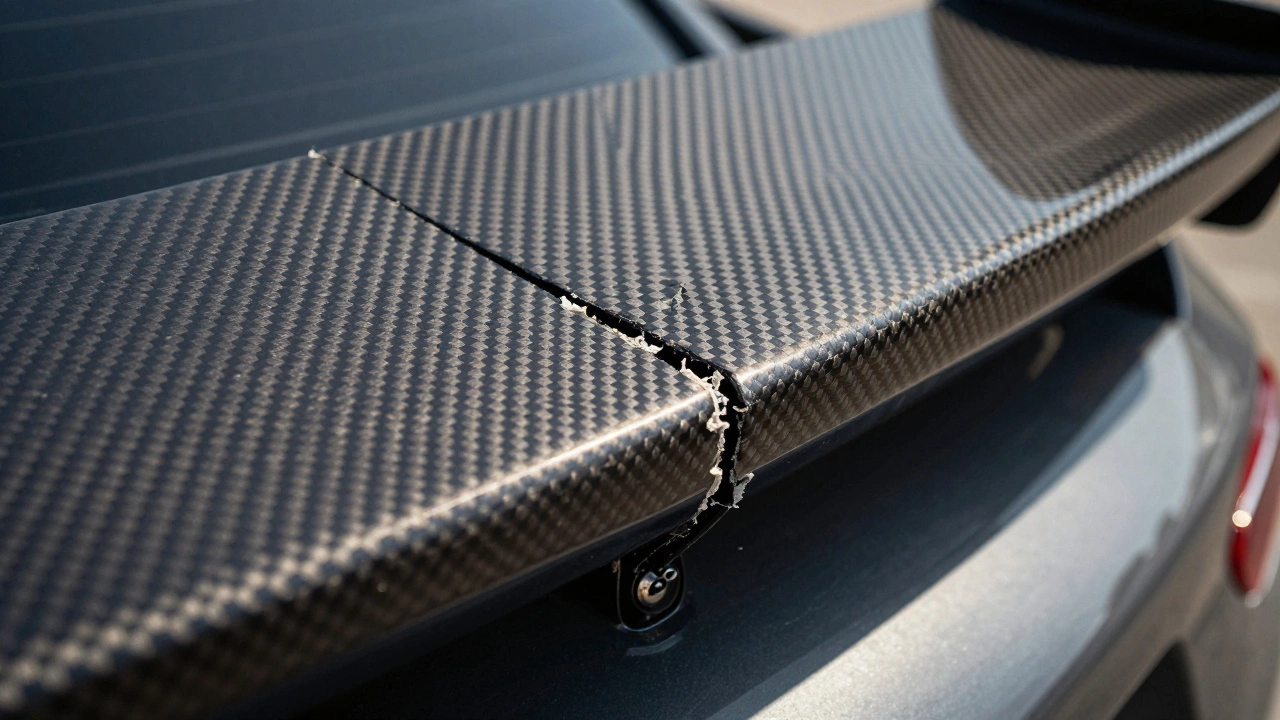
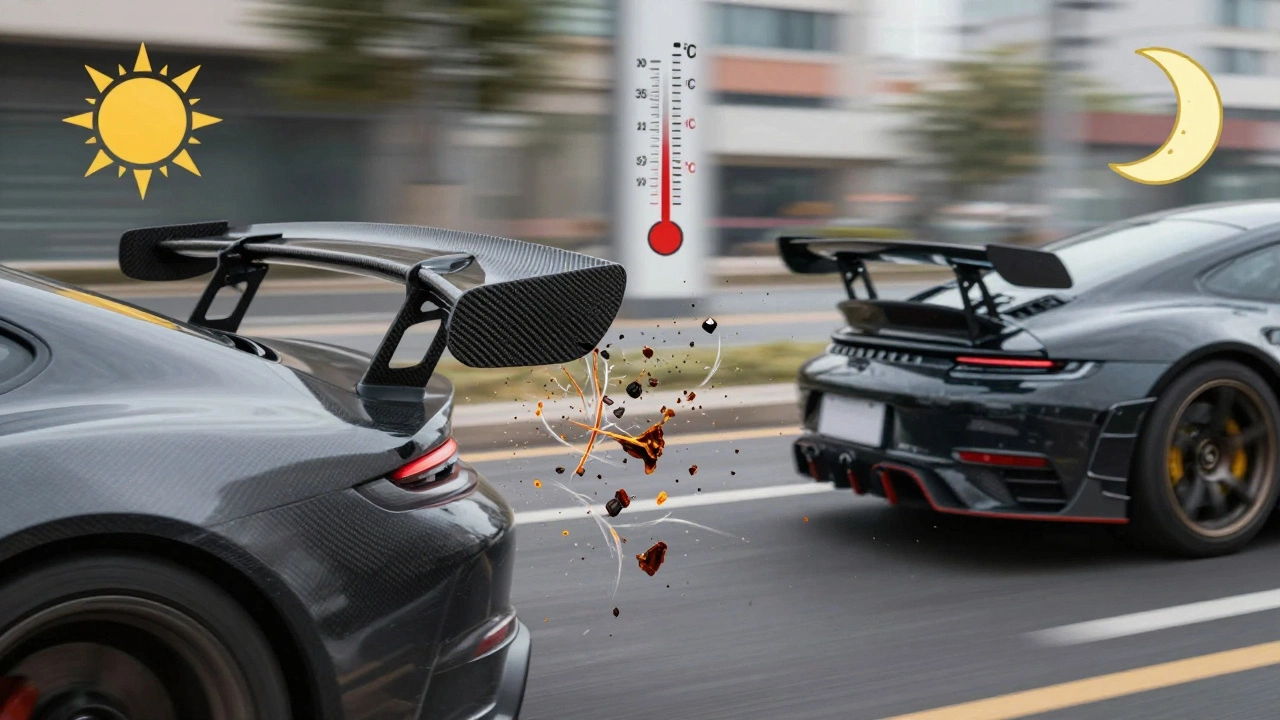
Carbon fibers themselves are incredibly strong - five times stronger than steel by weight. But the epoxy resin that binds them? It’s brittle. It doesn’t flex. It cracks under stress, especially when hit at an angle or exposed to repeated temperature swings. A spoiler might look perfect on the showroom floor, but after a few months of hot Brisbane sun baking it daily, followed by cool night air, that resin starts to micro-crack. Those cracks grow. Eventually, you get a visible split - often near the mounting points or along edges where stress concentrates.
Impact damage is invisible until it’s too late
Unlike metal, which dents or bends visibly, carbon fiber can suffer internal damage without showing any signs on the surface. A small rock hit at highway speed? A curb scrape? A dropped tool during installation? These can delaminate the layers inside the carbon fiber without leaving a scratch.
That’s why a carbon fiber spoiler that looks fine after a minor accident might fail completely weeks later. The layers separate. The structure loses rigidity. It starts to vibrate. Then it cracks. You don’t notice until it’s falling off at 100 km/h.
Real-world example: A 2023 Subaru WRX owner in Melbourne reported his aftermarket carbon fiber rear spoiler cracked cleanly along the centerline after hitting a pothole. No visible dent. No scuff. Just a clean fracture. The shop confirmed it was internal delamination from the impact. The resin had absorbed the shock but couldn’t redistribute the force across layers.
Temperature changes kill carbon fiber faster than you think
Carbon fiber expands and contracts at a different rate than the metal or plastic it’s mounted to. That mismatch creates constant stress at the attachment points. In Brisbane’s climate - where summer highs hit 35°C and winter nights dip to 12°C - that thermal cycling happens every single day.
Over time, that stress fatigues the bond between the spoiler and the trunk lid. Even high-quality 3M automotive adhesive can fail. Bolts loosen. The spoiler starts to rattle. Then the vibration cracks the resin around the mounting holes. That’s why so many carbon fiber spoilers end up with cracks radiating from the bolt holes - not from crashes, but from everyday temperature shifts.
Factory carbon parts are designed with this in mind. They use flexible mounts, rubber grommets, or even specialized thermal expansion joints. Aftermarket spoilers? Most are glued or bolted rigidly. No flexibility. No mercy.
UV exposure turns carbon fiber brittle
Not all carbon fiber spoilers are created equal. The ones you see on eBay or AliExpress for $150? They’re often made with low-grade resin and no UV protection. The clear coat is thin, or missing entirely.
Without proper UV-resistant topcoats, the resin degrades under sunlight. It becomes chalky. It loses elasticity. It turns from tough plastic into something that feels like hard styrofoam. One hard rain, one car wash with a stiff brush, and it flakes off - or cracks.
High-end spoilers use automotive-grade clear coats with UV stabilizers, similar to what’s used on race cars. These can last 10+ years. Cheap ones? They start failing after 6-12 months in full sun. If your spoiler looks faded or has a dull, matte finish instead of a glossy shine, the resin is already breaking down.
Weight isn’t always a benefit - it can be a trap
Carbon fiber is light. That’s why it’s popular. But lighter doesn’t always mean better. Some aftermarket manufacturers cut corners by using fewer layers of carbon weave. Less material = less weight = lower cost. But also less structural integrity.
A genuine OEM carbon fiber spoiler might use 6-8 layers of 3K weave. A budget version? Maybe 2-3 layers of cheaper 1K weave. The result? A spoiler that looks the same from 10 feet away, but flexes under aerodynamic load. At highway speeds, it vibrates like a guitar string. That vibration grinds away at the mounting points. It fatigues the resin. It leads to cracks.
Test this: Tap a carbon fiber spoiler with your knuckle. A solid one sounds like a drum. A thin, weak one sounds hollow. If it feels flimsy when you push on it, it’s not just cheap - it’s dangerous.
Installation mistakes make weaknesses worse
Even the best carbon fiber spoiler can fail if installed wrong. Too much torque on the bolts? You crush the resin. Not enough adhesive? It vibrates loose. Mounting on a dirty or oily surface? The bond fails. Using the wrong adhesive? It won’t handle heat or flex.
Many DIYers use double-sided tape meant for trim or badges. That’s not enough. Carbon fiber spoilers experience constant aerodynamic lift and downforce. They need structural-grade urethane adhesive - the same kind used on windshields. And they need clamps, pressure, and 24-48 hours to cure.
One Brisbane mechanic told me about a customer who glued his spoiler on with tape. It flew off at 110 km/h. Took out a rear window. No one was hurt. But the car was totaled. The spoiler wasn’t weak - the installation was.
Carbon fiber vs fiberglass: Which is actually tougher?
Many people assume carbon fiber is always superior to fiberglass. It’s not. In real-world conditions, fiberglass often outlasts cheap carbon fiber.
Fiberglass is more flexible. It absorbs impacts better. It doesn’t shatter under stress. It’s heavier, yes - but it doesn’t crack from temperature swings or UV exposure as easily. A quality fiberglass spoiler can last 15 years. A low-end carbon fiber one? Maybe 3.
Here’s the truth: If you want durability, go with fiberglass and paint it to match. If you want the carbon look without the fragility, buy a high-end carbon fiber spoiler from a reputable brand like APR, Vorsteiner, or OEM. Avoid the $200 eBay specials.
How to spot a weak carbon fiber spoiler before you buy
- Check the weave: Is it tight and even? Loose or uneven weave means poor manufacturing.
- Look at the edges: Are they clean and sealed? Exposed fibers mean no UV protection.
- Tap it: Solid sound = good. Hollow or dull sound = thin layers.
- Ask for the resin type: If they can’t tell you, walk away.
- Check the mounting hardware: Are there rubber washers or flexible mounts? If not, it’s a recipe for failure.
- Ask for proof of UV coating: If they say "it’s clear coat," ask what brand. If they don’t know, it’s probably not automotive-grade.
Can you fix a cracked carbon fiber spoiler?
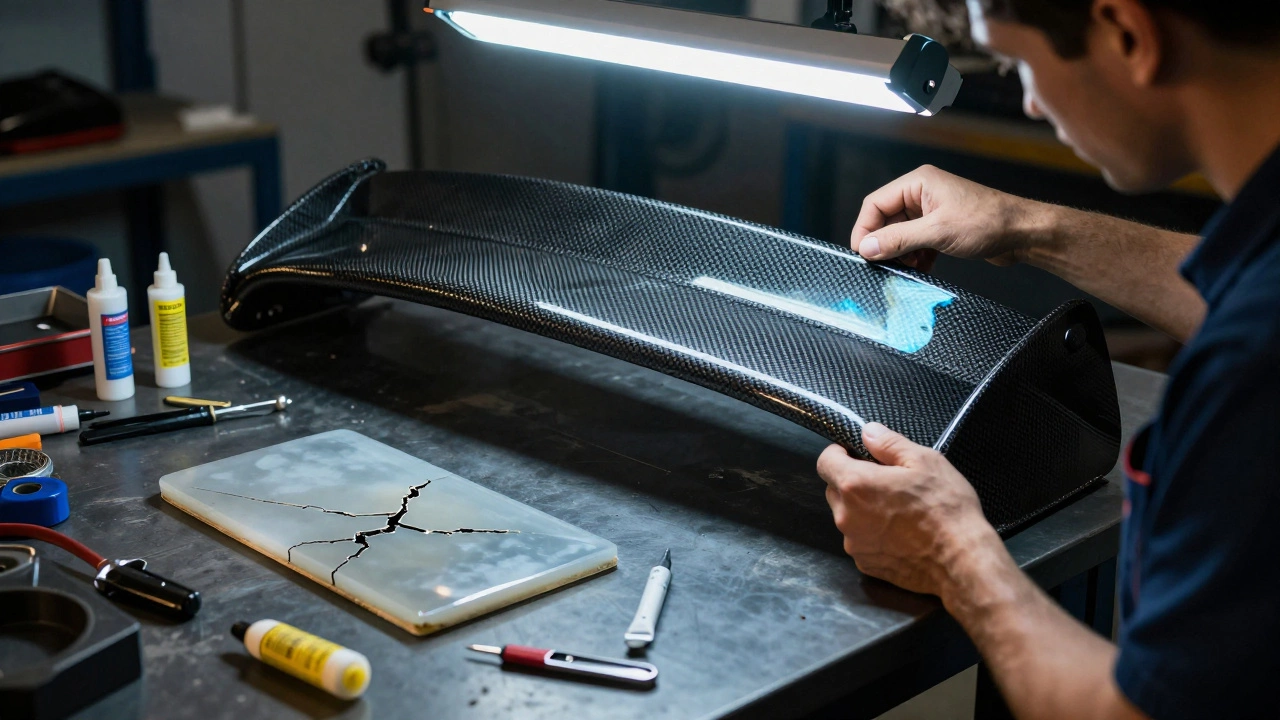
Technically, yes - but it’s rarely worth it. Carbon fiber repairs require vacuum bagging, heat curing, and precise layering. Most body shops can’t do it right. Even if they can, the repair will never be as strong as the original. It will always be a weak spot.
And if the crack is near a mounting point? That’s a structural failure. No patch job will hold up to aerodynamic loads. You’re just delaying the inevitable.
Replacement is almost always the safer, more reliable choice.
Bottom line: Carbon fiber is beautiful - but not bulletproof
Carbon fiber spoilers look amazing. They reduce weight. They improve aerodynamics. But they’re not magic. They’re a high-maintenance material that demands quality, proper installation, and protection from the elements.
If you want one, invest in a reputable brand. Don’t chase the lowest price. Understand that it needs care - no harsh car washes, no pressure sprays near the edges, no parking under direct sun for months on end.
And if you already have one that’s cracked? Don’t ignore it. That crack isn’t just cosmetic. It’s a warning sign. The spoiler could fail while you’re driving. That’s not a repair job - it’s a safety issue.
Carbon fiber isn’t weak because it’s carbon fiber. It’s weak because people treat it like it’s indestructible. It’s not. Treat it like the precision part it is - and it’ll last. Treat it like plastic, and it’ll break.
Is carbon fiber stronger than steel?
By weight, yes - carbon fiber is about five times stronger than steel. But strength isn’t the whole story. Steel bends and absorbs impact. Carbon fiber can shatter under sudden force. It’s strong in tension, but brittle under impact or shear stress. That’s why a steel bumper survives a parking lot bump, while a carbon fiber spoiler cracks.
Why do carbon fiber spoilers crack at the mounting points?
The mounting points experience constant stress from vibrations, aerodynamic forces, and temperature changes. Carbon fiber’s resin doesn’t flex, so the stress concentrates at those rigid attachment points. Over time, the resin cracks, then the fibers start to separate. This is why factory spoilers use flexible mounts or rubber grommets - to absorb that stress. Aftermarket ones rarely do.
Can UV rays really damage carbon fiber?
Yes. The epoxy resin that binds the carbon fibers breaks down under prolonged UV exposure. Without a proper automotive-grade UV clear coat, the resin becomes brittle, chalky, and cracks easily. That’s why cheap carbon fiber parts fade and flake after a year in the sun - the material underneath is already failing.
Are fiberglass spoilers better than carbon fiber?
For durability, yes - especially if you’re on a budget or live in a hot climate. Fiberglass is more flexible and absorbs impacts better. It doesn’t crack from temperature swings or UV exposure as easily. It’s heavier, but it lasts longer. A painted fiberglass spoiler can outlast a cheap carbon fiber one by years. The carbon look is just a finish - it doesn’t have to be carbon fiber to look good.
How do I know if my carbon fiber spoiler is low quality?
Look for loose or uneven weave, exposed fibers at the edges, a dull or matte finish, and hollow sound when tapped. If the seller can’t tell you the resin type or if it has UV protection, it’s low quality. Also check the mounting hardware - if it’s just bolts with no rubber washers, it’s not built for real-world use.