Car Detailing Profit Calculator
Calculate Your Earnings
How much money can you really make cleaning cars? If you’ve ever looked at a shiny, spotless sedan and thought, ‘I could do that’, you’re not alone. Thousands of people start car detailing businesses every year - but only a few stick around long enough to turn it into real income. The truth? Car detailing can be extremely profitable - if you know how to do it right. And no, it’s not just about buying a fancy detailing kit and calling yourself a professional.
What Actually Gets Paid For in Car Detailing
People don’t pay for soap and wax. They pay for results. A clean car is one thing. A show-quality car? That’s worth hundreds. Most customers aren’t looking for a basic wash. They want their car to look like it just rolled off the dealer lot - or better. That means paint correction, ceramic coating, interior steam cleaning, leather conditioning, and wheel restoration. These aren’t optional add-ons. They’re the core services that turn a $50 wash into a $400 detail.Take a typical mid-range sedan in Brisbane. A basic exterior wash and vacuum? That’s $60. A full detail - including clay bar, two-stage polish, sealant, interior deep clean, and tire dressing? That’s $320 to $450. Add ceramic coating, and you’re pushing $800. And yes, people pay that. I’ve had clients who bring their cars in every 3 months, year after year. One guy even paid $1,200 to restore his 2018 Porsche 911 after a bird-dropping incident. He didn’t blink.
The Real Cost of Starting a Detailing Business
You don’t need a garage. You don’t need employees. You don’t even need a storefront. You need tools, time, and a reliable vehicle. Here’s what a solid starter setup costs in 2025:- High-quality dual-action polisher: $350
- Set of microfiber towels (50+): $120
- Steam cleaner for interiors: $400
- Paint correction compounds and sealants (first batch): $250
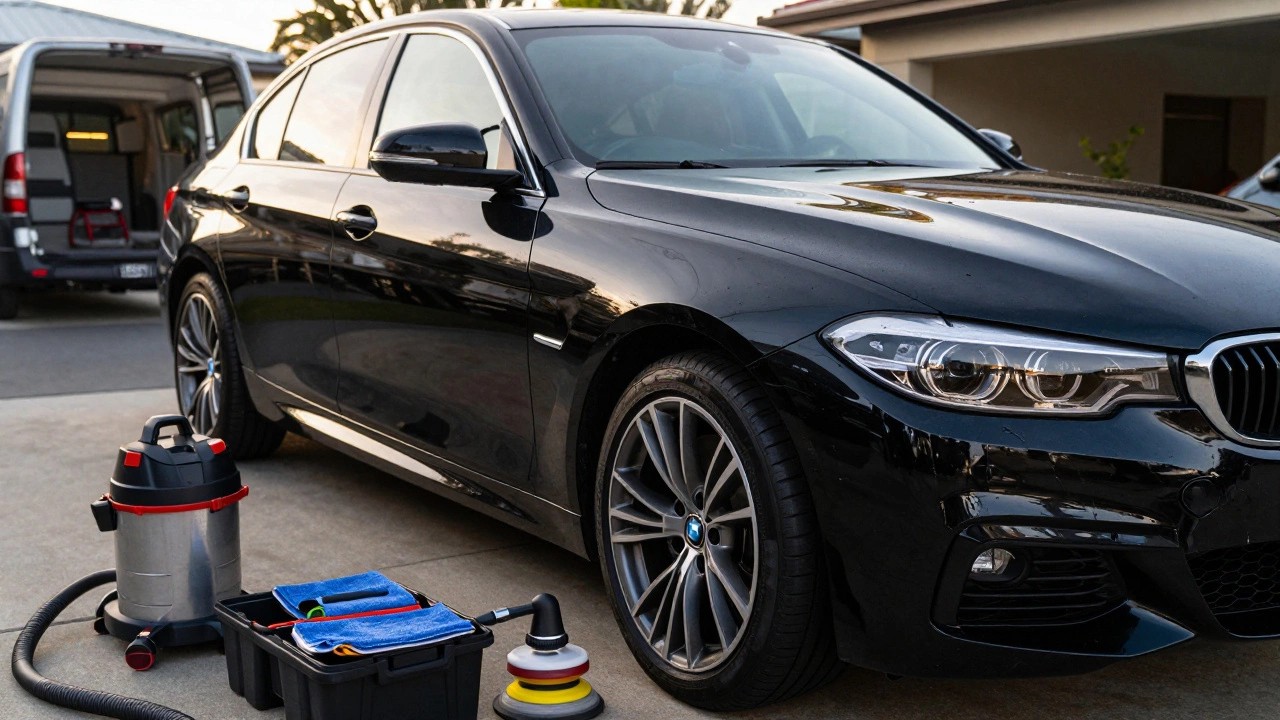
- Mobile detailing kit (case, hoses, vacuum, water tank): $600
- Insurance and registration: $150/year
- Marketing (signage, business cards, Facebook ads): $200
Total upfront cost? Around $2,070. That’s it. No rent. No staff salaries. No utilities beyond your own electricity and water. Compare that to opening a coffee shop ($150,000+) or a gym ($50,000+). Detailing is one of the lowest-barrier, highest-margin businesses you can start.
How Many Cars Can You Detail in a Day?
This is where most people get it wrong. You can’t detail five cars a day if you’re doing full work. But you don’t need to. A full detail takes 4 to 6 hours. A quick detail (exterior polish + interior vacuum + tire shine) takes 2 hours. Most professionals work 4 to 5 days a week, doing 2 to 3 cars per day.Let’s say you do three full details a week at $350 each. That’s $1,050 a week. Four weeks? $4,200 a month. Subtract $500 for supplies, fuel, and cleaning products - you’re left with $3,700. That’s a full-time income, working 20 hours a week. Do five cars a week? You’re hitting $6,000+ before taxes. And that’s without charging extra for ceramic coating, paint protection film, or headlight restoration - all high-ticket add-ons.
Mobile vs. Shop-Based: Which Makes More Money?
You have two options: go mobile or set up a shop. Most beginners start mobile. It’s cheaper, faster, and easier to scale. You drive to the customer’s home, office, or driveway. No overhead. No rent. No cleaning crew to manage. You’re the only one who shows up with your gear.But here’s the catch: mobile detailers can’t charge as much as shop-based ones - at first. A shop can offer more services, like paint correction bays, climate-controlled drying rooms, and advanced equipment. That justifies higher prices. But the trade-off? Rent in Brisbane can be $2,000 to $4,000 a month. You need to do 8 to 10 cars a week just to break even.
Most successful detailers start mobile, build a client base, then open a small shop after 12 to 18 months. By then, they’re already making $5,000 to $8,000 a month. The shop isn’t the start - it’s the upgrade.
What Detailing Kits Actually Matter
You’ll see a million ‘pro’ detailing kits on Amazon. Most are garbage. You don’t need 30 different sponges. You need a few key things:- A dual-action polisher with variable speed (not a cheap random orbital)
- High-quality microfiber towels (cut from 100% polyester, not blended)
- True clay bar (not the fake ‘clay-like’ sponge)
- Paint sealant or ceramic coating (not spray wax)
- A portable vacuum with strong suction (not the kind you use for your couch)
- A steam cleaner that actually reaches 250°F+
Brands like Meguiar’s, Chemical Guys, and Gtechniq aren’t expensive because they’re fancy. They’re expensive because they work. A $40 bottle of spray wax from Walmart might last one wash. A $60 bottle of ceramic coating lasts 2 years. That’s not a cost - it’s an investment.
Who Pays for Detailing? The Real Customer Profile
Don’t waste time trying to sell to students or people driving 15-year-old Toyotas. The people who pay big money for detailing are:- Professionals with luxury cars (BMW, Mercedes, Tesla, Audi)
- Car collectors and enthusiasts
- People who lease vehicles and want to avoid end-of-lease fees
- Real estate agents who detail their loaner cars
- Uber and Lyft drivers who want to stand out and get higher ratings
These customers don’t care about the cheapest option. They care about quality, reliability, and results. They’ll pay $500 to keep their car looking perfect. They’ll refer you to their friends. And they’ll come back every quarter.
Why Most Detailing Businesses Fail
It’s not the competition. It’s not the weather. It’s not even the price. Most people fail because they treat detailing like a chore - not a service.You’re not cleaning cars. You’re selling peace of mind. You’re selling confidence. You’re selling the feeling that their car is special. If you show up late. If you skip a step. If you use the wrong product - you lose trust. And trust is the only thing that keeps customers coming back.
Also, don’t undercharge. Charging $50 for a full detail doesn’t make you ‘affordable.’ It makes you look like a beginner. It attracts the wrong clients. And it kills your profit margin. Charge what you’re worth. Educate your customers. Show them the difference between a good clean and a professional detail.
How to Scale Beyond One Person
Once you’re doing 15 to 20 cars a week, you can start hiring. But don’t hire just anyone. Train someone to do the same level of work you do. Pay them $30 to $40 an hour. Have them handle basic details while you take on the high-end jobs. You can easily double your income by working smarter, not harder.Some detailers open a second location. Others create a subscription model - $99/month for a monthly detail. Others partner with car dealerships or luxury car clubs. The options multiply once you’ve proven the system works.
Real Numbers: What a Brisbane Detailer Made Last Year
A friend of mine - let’s call him Mark - started mobile detailing in 2023 with $2,500 in gear. He worked 3 days a week, averaging 3 cars per day. He charged $350 for full details, $150 for quick cleanups, and added ceramic coating for $500 extra.Here’s what he made in 2024:
- 144 full details @ $350 = $50,400
- 88 quick cleanups @ $150 = $13,200
- 22 ceramic coatings @ $500 = $11,000
- 15 headlight restorations @ $120 = $1,800
Total revenue: $76,400. Supplies, fuel, and ads: $6,200. Net profit: $70,200. He didn’t work weekends. He didn’t take holidays. He worked 20 hours a week. That’s $3,500 a month in pure profit. And he’s still growing.
Final Answer: Yes, Car Detailing Is Profitable - If You Do It Right
Car detailing isn’t a side hustle. It’s a real business. And like any business, it rewards skill, consistency, and professionalism. You don’t need a degree. You don’t need a loan. You just need to learn the craft, charge fairly, and treat every car like it’s your own.Start small. Build trust. Deliver results. The money follows.
Can you make a living from car detailing?
Yes, absolutely. Many detailers in Australia earn between $50,000 and $100,000 a year working 20 to 30 hours a week. Profit margins are high because overhead is low. The key is charging for quality, not just time. A detailer doing 3 full services a week at $350 each can make over $50,000 annually before expenses.
How much does a car detailing kit cost?
A professional-grade starter kit costs between $1,800 and $2,500. This includes a dual-action polisher, microfiber towels, clay bar, paint sealant, steam cleaner, vacuum, and water tank. Avoid cheap kits under $500 - they often contain low-quality tools that break or don’t deliver results. Investing in good gear saves money in the long run.
Do you need a license to detail cars in Australia?
No specific license is required to detail cars in Australia. However, you do need a standard business ABN and public liability insurance. Some local councils may require a mobile business permit if you operate in certain suburbs. Always check your local council rules - especially if you’re using water on the street.
Is ceramic coating worth the extra cost?
Yes, if you’re targeting premium clients. Ceramic coating lasts 2 to 5 years and protects against UV damage, bird droppings, and light scratches. It costs $400 to $800 to apply, but customers are willing to pay $500 to $1,200 for the service. It’s one of the highest-margin add-ons in detailing - often 90% profit after materials.
How do I find customers for my detailing business?
Start with Facebook Groups, Nextdoor, and Instagram. Post before-and-after photos of real jobs. Offer a discount for referrals. Partner with local car washes, dealerships, or Uber drivers. Word-of-mouth is your strongest tool - one happy client can bring you five more. Don’t waste money on Google Ads until you’ve proven your service.
How long does a full car detail take?
A full detail takes 4 to 6 hours for a standard sedan. Larger vehicles like SUVs or trucks take 6 to 8 hours. A quick detail (exterior polish + interior vacuum) takes 2 hours. The time depends on the car’s condition. A neglected vehicle with heavy swirls or stains can take two full days.
Can I detail cars in my driveway or street?
Yes, in most Australian suburbs. However, some councils restrict water runoff into storm drains. Use a waterless wash or a portable water tank with a containment system. Always check local regulations - Brisbane City Council, for example, discourages washing cars on driveways during drought warnings. Mobile detailers often use portable systems to stay compliant.