K&N Horsepower Gain Calculator
Vehicle Configuration
Estimated Power Gain
at the wheels
You’ve seen the ads. You’ve heard the garage talk. A simple swap of your paper air filter for a K&N air filter promises free horsepower, better throttle response, and improved fuel economy. It sounds too good to be true, doesn’t it? The reality is more nuanced than the marketing brochures suggest.
If you are looking for a magic bullet that adds 50 horsepower to your daily driver just by changing a filter, you are going to be disappointed. But if you want to understand exactly what this modification does to your engine’s breathing, how much power you can realistically expect, and whether the investment makes sense for your specific vehicle, we need to look at the data-not the hype.
Quick Answer: How much HP does a K&N add?
On a stock engine with a stock intake system, a direct-fit K&N air filter typically adds between 3 to 5 horsepower at the wheels. If paired with a cold air intake system, gains can range from 8 to 12 horsepower. These numbers vary significantly based on engine size, turbocharging, and existing restrictions.
The Science of Airflow and Restriction
To understand why a filter changes horsepower, you have to understand how an internal combustion engine works. Your engine is essentially an air pump. It sucks in air, mixes it with fuel, compresses it, and ignites it. The more air you can get into the cylinder, the more fuel you can burn, and the more power you create.
Stock paper air filters are designed for one thing: filtration. They are excellent at keeping dust and debris out of your engine, but they do this by creating resistance. Think of it like trying to breathe through a thick coffee filter. It’s possible, but it takes effort. This restriction is called "pressure drop." In automotive terms, high pressure drop means your engine has to work harder to pull in air, which saps a tiny amount of power.
K&N air filters use a multi-layer cotton gauze material oiled to trap particles while allowing larger volumes of air to pass through compared to standard paper filters. This design reduces the pressure drop, making it easier for the engine to breathe. However, reducing restriction only helps if the rest of the intake system is already efficient. If your stock intake tube is narrow or twisted, simply swapping the filter won’t solve the bottleneck.
Direct-Fit Filters vs. Cold Air Intakes
This is where most people get confused. There are two ways to install a K&N product, and the horsepower gains are drastically different for each.
1. Direct-Fit Replacement
This is when you buy a K&N filter that looks exactly like your stock paper filter and fits into your existing plastic airbox. You keep the same mass air sensor (MAF), the same intake tubing, and the same heat shields. You are only changing the media inside the box.
In this scenario, the gains are minimal. Because the physical path the air travels hasn’t changed, the only improvement is the reduced resistance of the filter media itself. For most naturally aspirated cars, this translates to roughly 3-5 horsepower. You might notice slightly sharper throttle response, especially at lower RPMs, because the engine doesn’t have to fight as hard to draw air through the filter surface.
2. Cold Air Intake Systems
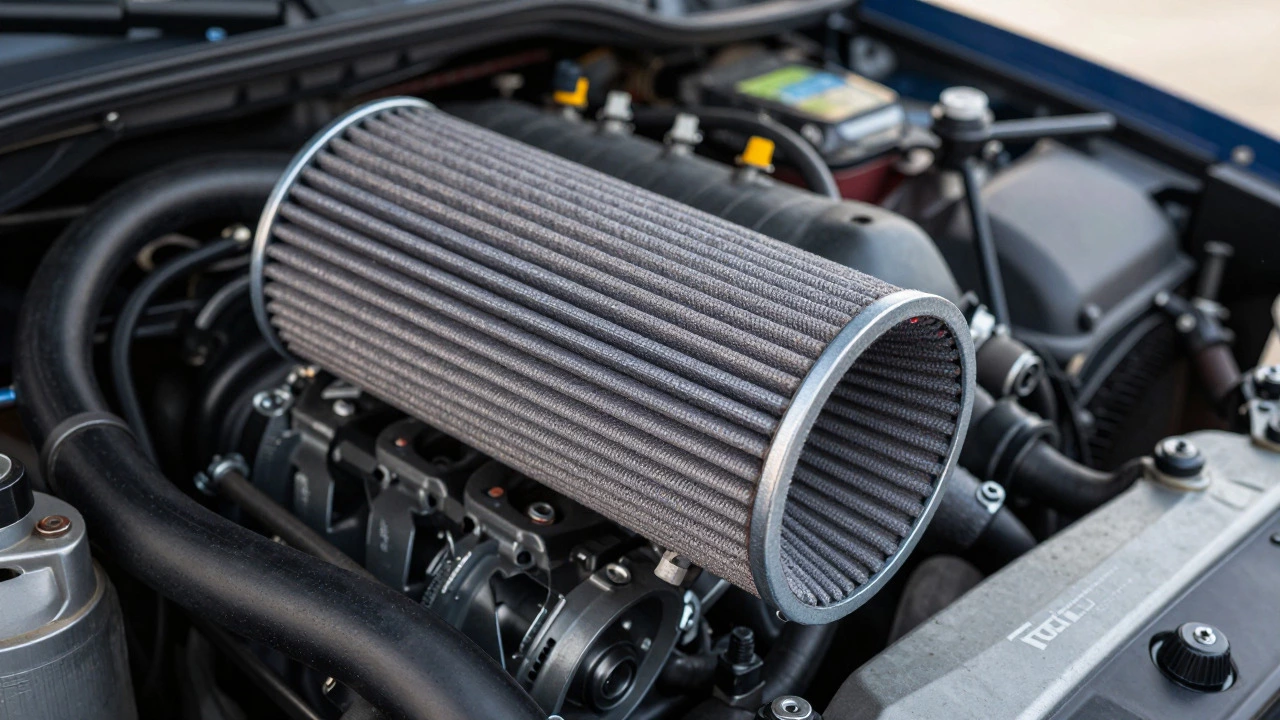
This involves replacing the entire stock airbox and intake tube with a smoother, wider pipe that draws air from further away from the hot engine bay-usually near the wheel well. This cooler, denser air burns more efficiently. When you pair a K&N conical filter with a proper cold air intake tube, you are addressing both temperature and volume.
Here, the gains become more noticeable. Depending on the vehicle, you can see anywhere from 8 to 12 additional horsepower. Turbocharged engines often see even less gain from intakes alone because the turbocharger is already forcing air into the engine, but they may benefit from slightly spooling faster due to reduced backpressure.
| Modification Type | Engine Type | Avg. HP Gain (Rear Wheel) | Noticeable Difference? |
|---|---|---|---|
| Direct-Fit K&N Filter | Naturally Aspirated | 3 - 5 HP | Slight throttle sharpening |
| Direct-Fit K&N Filter | Turbocharged | 1 - 3 HP | Minimal to none |
| K&N Cold Air Intake | Naturally Aspirated | 8 - 12 HP | Yes, audible induction noise |
| K&N Cold Air Intake | Turbocharged | 5 - 8 HP | Moderate, mainly spool time |
Does Engine Size Matter?
Absolutely. The percentage of gain matters more than the absolute number. A 4-cylinder engine with 150 horsepower will feel a bigger difference from a 5-horsepower gain than a V8 with 400 horsepower will. That 5 HP represents a 3.3% increase for the small engine, but only a 1.25% increase for the big one.
Larger displacement engines generally move more air volume. If your stock intake system was designed poorly, a high-flow filter can help unlock some of that trapped potential. However, modern manufacturers tune their stock intakes very carefully. They balance filtration, noise suppression, and airflow. Disrupting that balance with a direct-fit filter rarely yields massive results because the engineering team already optimized the airbox geometry for that specific engine.
The Maintenance Factor: Oiling and Cleaning
One major difference between K&N filters and stock paper filters is longevity. Paper filters are disposable; K&N filters are reusable. Over the life of the car, this can save you money. However, this convenience comes with a responsibility: maintenance.
K&N filters rely on oil to trap microscopic particles. If the filter gets too dirty, the pores clog, and the flow rate drops back down to-or even below-that of a clean paper filter. If the filter isn’t oiled correctly, it can let dirt through, causing engine wear. Conversely, if you over-oil it, excess oil can be sucked into the Mass Air Sensor (MAF).
A dirty MAF sensor sends incorrect data to the Engine Control Unit (ECU), leading to poor fuel mixture, rough idling, and check engine lights. This is a common issue reported by owners who neglect to clean their K&N filters every 100,000 miles or so. You must follow the cleaning kit instructions precisely: wash, dry completely, re-oil evenly, and wait before reinstalling.
Fuel Economy Claims
K&N often advertises improved gas mileage. Is this real? In controlled testing, yes, but the margin is slim. Better airflow can lead to more complete combustion, which might squeeze out an extra 1-2 MPG under ideal highway conditions. However, driving style plays a much larger role. If the louder intake sound inspires you to drive more aggressively, you will likely lose any fuel savings gained from efficiency. For most drivers, the fuel economy impact is negligible.
When Does a K&N Filter Make Sense?
So, should you buy one? Here is the decision tree:
- You want easy maintenance: If you hate paying $20-$40 every time you need a new filter, a K&N pays for itself over five years.
- You are building a track car: Every bit of airflow counts. Pairing a K&N with a full intake system and ECU tuning can yield significant gains.
- You love the sound: Many cold air intakes add an aggressive induction noise that many enthusiasts find satisfying.
- You live in a dusty area: Be cautious. While K&N filters are durable, extreme dust environments can clog them faster than expected. Regular inspection is key.
If you are looking for cheap horsepower on a stock commuter car, manage your expectations. You won’t turn your sedan into a sports car. But you will get a cleaner-looking engine bay, easier maintenance, and a marginal bump in performance that, when combined with other mods, contributes to a better overall driving experience.
Common Pitfalls to Avoid
Don’t just slap a conical filter onto a stock car without sealing it properly. Heat soak is a real enemy. If hot air from the radiator is being sucked directly into your engine because you removed the heat shield of the stock airbox, you will actually lose power. Hot air is less dense, meaning fewer oxygen molecules per cubic inch. Always ensure your intake setup pulls cool air from outside the engine bay.
Also, beware of "universal" kits that require cutting holes in your fenders. Unless you are careful with heat shielding and sealing, water intrusion during rain can cause hydrolock-a catastrophic failure where water enters the cylinders. Stick to bolt-on, application-specific designs whenever possible.
Will a K&N air filter void my warranty?
Generally, no. Under laws like the Magnuson-Moss Warranty Act in the US, manufacturers cannot void your entire warranty just because you installed an aftermarket part. They must prove that the part caused the specific damage. However, if a dirty K&N filter lets sand into your engine and destroys the pistons, they can deny coverage for that repair. Keep records of your maintenance to protect yourself.
How often should I clean a K&N filter?
K&N recommends cleaning every 100,000 miles under normal conditions. If you drive in dusty, sandy, or off-road environments, check it every 10,000 to 20,000 miles. Visual inspection is key-if it looks caked with grime, it’s time to clean it.
Can I put a K&N filter on a diesel truck?
Yes, and it’s very popular. Diesel engines run lean and require massive amounts of air. High-flow filters can help improve turbo spool and potentially fuel efficiency. However, diesel particulate filters (DPF) are sensitive, so ensuring proper filtration is critical to avoid clogging the DPF.
Is there a noticeable sound difference?
With a direct-fit filter, the sound change is minimal. With a cold air intake system, you will hear increased induction noise, especially under acceleration. Some people love this "whoosh" sound; others find it distracting. Listen to reviews for your specific car model first.
Do K&N filters last forever?
No. The cotton gauze degrades over time, especially if cleaned improperly or exposed to harsh chemicals. Most K&N filters have a lifespan of 5-10 years depending on usage. Eventually, the material loses its ability to hold oil and filter effectively, requiring replacement.