Exhaust Size Calculator for 350 HP
Recommended Exhaust Diameter
So, you’ve got a car putting out 350 hp. That’s a sweet spot. It’s enough power to make your heart race on the highway but not so much that you’re breaking the sound barrier every time you tap the gas. But here is the problem: if your exhaust system is too small, you are literally choking your engine. If it is too big, you lose torque and the car feels flat at low speeds. Getting this right isn't just about noise; it is about physics.
The short answer? For most naturally aspirated engines making around 350 horsepower, a **2.5-inch to 3-inch** single exhaust or dual 2.5-inch pipes is usually the gold standard. But "usually" doesn't help when you are standing in front of a rack of pipes wondering which one to buy. Let’s break down exactly how to calculate the right size for your specific build, because a turbocharged V6 needs a different setup than a supercharged V8.
The Physics of Flow: Why Size Matters
To understand why we pick certain sizes, we have to look at exhaust velocity. Your engine doesn’t just want to push gas out; it wants to pull fresh air in. This happens through a phenomenon called scavenging. When exhaust gases leave the cylinder at high speed, they create a low-pressure zone behind them. This vacuum helps suck the next charge of fuel and air into the engine.
If your pipe is too narrow, the gas gets stuck. This creates backpressure. Think of it like trying to drink a thick milkshake through a skinny straw. You can do it, but it takes effort, and you aren’t getting the full volume quickly. High backpressure means your engine has to work harder to push out spent gases, which robs you of horsepower.
On the flip side, if the pipe is too wide, the gas moves too slowly. The scavenging effect disappears because there is no high-velocity rush of gas to create that vacuum. The result? You lose low-end torque. Your car might rev fine at 6,000 RPM, but from 1,000 to 3,000 RPM, it will feel sluggish and unresponsive. For a street car, losing low-end torque is a dealbreaker because that’s where you drive 90% of the time.
Naturally Aspirated vs. Forced Induction: The Big Divide
The type of engine you have changes everything. A naturally aspirated (NA) engine relies entirely on atmospheric pressure to fill its cylinders. It produces less volumetric flow compared to a forced induction engine of the same horsepower rating. Therefore, NA engines generally benefit from slightly smaller piping to maintain higher gas velocities.
Turbocharged and Supercharged Engines are forced induction systems that compress air before it enters the engine, significantly increasing mass airflow and requiring larger exhaust diameters to handle the increased volume of exhaust gases efficiently. Because these engines move more air, they produce more exhaust volume. They can handle-and often require-larger pipes to prevent excessive backpressure from building up under boost.
Here is the general rule of thumb based on engine type for a 350 hp output:
- Naturally Aspirated V8: Dual 2.5-inch pipes or a single 3-inch pipe. The V8 configuration already splits the flow between two banks, so 2.5 inches per bank is plenty to keep velocity high without restricting flow.
- Turbocharged Inline-4 or V6: Single 3-inch to 3.5-inch pipe. Since all cylinders dump into one manifold and then one turbine, you need a large diameter to clear the massive volume of gas generated by boost.
- Supercharged V8: Dual 2.75-inch to 3-inch pipes. The blower adds volume, but the V8 split still helps manage flow. Going larger than 3 inches here often kills torque.
Calculating Your Ideal Diameter
If you want to get scientific about it, you can use a simple formula derived from fluid dynamics. While it’s not perfect for real-world applications due to bends and mufflers, it gives you a solid starting point. The goal is to match the pipe area to the engine's displacement and RPM range.
A widely accepted heuristic among performance tuners is that for every 100 horsepower, you need approximately 0.5 square inches of exhaust area. However, a simpler method involves looking at the relationship between bore size and pipe diameter. Many experts suggest that the exhaust pipe diameter should be roughly equal to the intake valve diameter or slightly larger.
For a 350 hp engine, let’s look at the math practically. If you have a single exit, you are dealing with the total flow. If you have dual exits, you split the load. Here is a quick reference table to help you visualize the differences:
| Engine Type | Configuration | Recommended Diameter | Best Use Case |
|---|---|---|---|
| Naturally Aspirated V8 | Dual Exit | 2.5 inches | Daily driving, strong mid-range torque |
| Naturally Aspirated V8 | Single Exit | 3.0 - 3.25 inches | Track use, high-RPM focus |
| Turbocharged I4/V6 | Single Exit | 3.0 - 3.5 inches | High boost levels, top-end power |
| Supercharged V8 | Dual Exit | 2.75 - 3.0 inches | Balanced torque and horsepower |
| Rotary Engine | Single/Dual | 3.0 inches (single) | High RPM operation, heat management |
The Role of Mufflers and Resonators
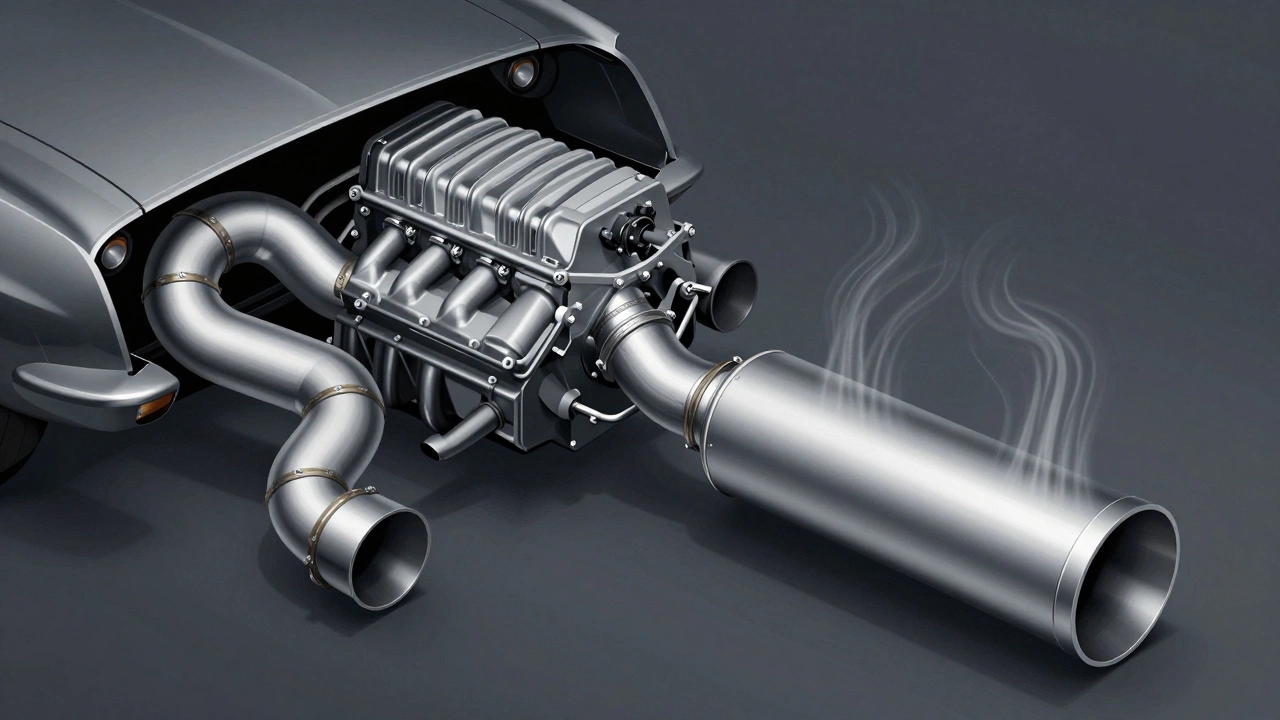
Pipe diameter is only half the battle. What happens inside the muffler matters just as much. A straight-through perforated tube muffler offers less restriction than a chambered muffler, but it is louder. If you choose a restrictive muffler, you might need to bump up your pipe size by 0.25 inches to compensate for the added resistance.
Resonators are another factor. These devices cancel out specific frequencies to reduce drone without killing flow. In a 350 hp daily driver, a resonator-deleted system might sound great at the track but unbearable on a long highway commute. Keep the resonators if you plan to drive more than 20 miles a day.
Also, consider the material. Stainless steel expands differently than aluminized steel when hot. A well-fitted stainless system maintains its shape better over time, ensuring that the internal diameter doesn’t warp or collapse due to heat cycles. This consistency keeps your flow rates predictable.
Common Mistakes to Avoid
I see this all the time: people buying the biggest pipes they can find because they think bigger equals faster. It doesn’t. Here are the three biggest pitfalls when sizing an exhaust for a 350 hp build:
- Ignoring the Downpipe (Turbo Cars): If you have a turbo, your downpipe is critical. A stock downpipe is often 2.25 inches. Upgrading to a 3-inch downpipe is often more beneficial than upgrading the rear pipes. If your downpipe is restricted, nothing else matters.
- Mixing Diameters Incorrectly: Never step down in diameter after stepping up. For example, don’t go from a 3-inch header collector to a 2.5-inch mid-pipe. Always maintain or increase diameter as you move away from the engine to accommodate expanding gas volume.
- Overlooking Bends: Sharp 90-degree bends restrict flow more than gentle sweeps. If your custom exhaust has tight corners to fit under the chassis, you may need a slightly larger diameter to offset the turbulence created by those bends.

Real-World Testing: Dyno Data Insights
Let’s talk numbers. On a dyno, we often see that a 2.5-inch dual exhaust on a 350 hp LS-based V8 peaks at 5,500 RPM. Push the pipe size to 3.0 inches, and that peak shifts to 6,500 RPM, but you lose 15 lb-ft of torque at 3,000 RPM. For a street car, that trade-off is bad. You spend most of your time below 4,000 RPM.
Conversely, on a turbocharged Subaru WRX making 350 whp, a 2.5-inch single exhaust might show a gain of 5 hp over stock, but a 3-inch system shows a gain of 12 hp at the top end, with only a minor drop in low-end torque. The turbo compresses the air, so the engine is less sensitive to low-velocity exhaust gases at lower RPMs.
This data reinforces the idea that there is no universal answer. You must match the exhaust to the engine’s breathing characteristics. If you are unsure, start conservative. It is easier to cut open a 2.5-inch pipe and weld in a 3-inch section than it is to shrink a 3.5-inch pipe down to 2.5 inches.
Legal and Noise Considerations
In many regions, including Brisbane where I live, noise ordinances are strict. A 3-inch straight pipe on a 350 hp car will likely fail a noise inspection and annoy your neighbors. Ensure your exhaust system includes proper baffling or a high-flow muffler that meets local decibel limits. Remember, a loud car isn’t necessarily a fast car, but a quiet car that passes inspection is a car you can actually drive.
Is 3 inch exhaust too big for 350 hp?
It depends on the engine type. For a naturally aspirated V8, dual 3-inch pipes might be slightly oversized and could reduce low-end torque. However, for a turbocharged inline-4 or V6, a single 3-inch pipe is ideal and often necessary to handle the increased exhaust volume from boost. Always consider whether you have a single or dual exit system.
Does exhaust size affect horsepower?
Yes, significantly. An undersized exhaust creates backpressure, forcing the engine to work harder to expel gases, which reduces horsepower. An oversized exhaust reduces exhaust gas velocity, harming scavenging and reducing torque, particularly at lower RPMs. The correct size optimizes both flow and velocity for maximum power across the rev range.
What is the best exhaust size for a V8 with 350 hp?
For a naturally aspirated V8 producing 350 hp, dual 2.5-inch exhaust pipes are generally the best choice for street driving. This size maintains good exhaust velocity for torque while providing enough flow for the horsepower. If you prefer a single exit, a 3.0-inch to 3.25-inch pipe is appropriate.
Can I use a 2.5 inch exhaust on a turbo car?
You can, but it may limit your potential. For a turbocharged engine making 350 hp, a 2.5-inch exhaust might cause excessive backpressure at high boost levels, leading to heat soak and reduced efficiency. A 3-inch or larger exhaust is typically recommended to ensure free flow of compressed exhaust gases.
How do I know if my exhaust is too big?
If your car feels sluggish at low RPMs (below 3,000 RPM) and lacks acceleration punch in city driving, your exhaust might be too large. You may also notice a "flat" sound profile with little bass. Conversely, if the car sounds like it's running out of breath at high RPMs and loses power near the redline, the exhaust is likely too small.