Exhaust Size Calculator for 400hp
Calculate Your Exhaust Size
Results
Recommended Exhaust Size:
3.0 inches
For your 400hp 4-Cylinder Turbo street car, the optimal exhaust size is 3.0 inches.
Why This Size?
At 400hp, a 3.0-inch exhaust provides the best balance of flow, scavenging, and low-end torque. It's the sweet spot for turbocharged engines while maintaining street-friendly sound quality.
Warning: Going larger than recommended can reduce low-end torque and create excessive noise. Stick to the calculated size for optimal performance.
When you hit 400 horsepower, your engine isn’t just making noise-it’s demanding airflow. A stock exhaust system will choke it. But picking the right exhaust size isn’t about going as big as possible. Too small, and you’re restricting flow. Too big, and you lose low-end torque and sound quality. So what size exhaust for 400hp? The sweet spot is usually between 3 inches and 3.5 inches for most street and track cars.
Why Exhaust Size Matters More Than You Think
Exhaust flow isn’t just about letting gases out. It’s about pressure management. Your engine creates exhaust pulses-rapid bursts of hot gas that need to exit cleanly. If the pipe is too narrow, those pulses back up, increasing backpressure. That means less room for fresh air to enter the cylinders, and you lose power. If the pipe is too wide, the gas velocity drops too much. That hurts scavenging-the effect where fast-moving exhaust pulls the next pulse out efficiently. No scavenging? You lose torque, especially under 3,000 RPM.
At 400hp, you’re in the range where cylinder volume and exhaust energy are high enough to need serious flow. Most 4-cylinder turbo engines making this power (like a Subaru WRX STI or Honda K20 swap) run best with 3-inch systems. V6 and V8 setups often need 3.5 inches because they produce more volume and lower-frequency pulses that need wider pipes to move efficiently.
How to Calculate the Right Size
You don’t need an engineering degree, but you do need to understand the basics. A simple rule of thumb used by custom fabricators is:
- For every 100 horsepower, you need about 0.5 square inches of exhaust cross-sectional area.
- That means 400hp = 2 square inches of total flow area.
Now, pipe diameter determines that area. A 3-inch pipe has a cross-section of about 7.07 square inches. A 3.5-inch pipe is about 9.62 square inches. So even a 3-inch pipe gives you over 3 times the area you technically need. But here’s the catch: exhaust systems aren’t just pipes. They have mufflers, catalytic converters, bends, and resonators-all of which create restriction.
That’s why we go bigger than the bare minimum. A 3-inch system is ideal for turbocharged engines because it keeps gas velocity high enough for good scavenging, while still reducing backpressure. For naturally aspirated V8s, 3.5 inches helps manage the higher exhaust volume without slowing flow.
What About Dual Exhausts?
Dual exhaust systems are popular, but they don’t double your flow. Each side needs to be sized independently. Two 3-inch pipes = 14.14 square inches total-way more than you need. But if you split a 3.5-inch single system into two 2.5-inch pipes, you’re cutting flow by 30%.
For 400hp, the best dual setups use two 3-inch pipes or one 3.5-inch pipe that splits into two 3-inch pipes after the H-pipe or X-pipe. The crossover (H-pipe or X-pipe) balances pressure between the two sides, improves scavenging, and smooths out the sound. Skip it, and you’ll get a choppy, uneven tone-plus a loss of low-end torque.
Material and Design Matter Too
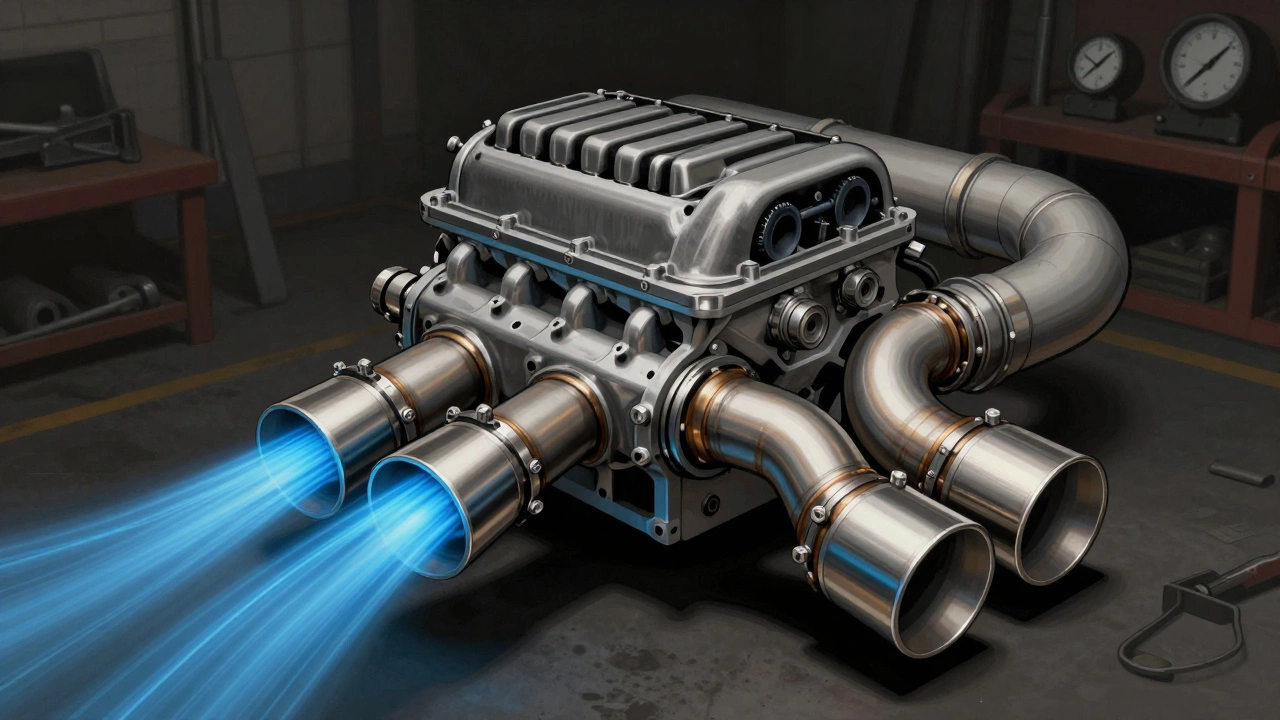
Size isn’t everything. A 3.5-inch stainless steel system with 90-degree bends and a cheap muffler will flow worse than a 3-inch system with mandrel-bent tubing and a free-flowing straight-through muffler.
- Mandrel bending keeps the pipe’s inner diameter consistent-no crushing or kinking.
- Aluminized steel is cheaper but rusts faster. Stainless steel lasts longer and resists heat better.
- Chambered mufflers add backpressure. Straight-through designs (like glasspacks or turbo mufflers) flow better.
- Resonators help tone down drone without killing flow. Skip them on race cars, but keep them on street cars.
For 400hp, go with 16-gauge or 14-gauge stainless steel. Avoid thin-wall tubing-it can warp under heat stress. And always make sure the exhaust exits behind the rear axle. A tailpipe that ends too far forward can cause fumes to enter the cabin.
Real-World Examples
Let’s look at real cars making 400hp:
- Toyota Supra 3.0 Twin-Turbo (400hp): Factory exhaust is 2.5 inches. Most tuners upgrade to 3-inch catback for better flow and sound.
- GM LS3 V8 (400hp): Factory dual 2.5-inch system. Aftermarket upgrades go to dual 3-inch or single 3.5-inch.
- Subaru WRX STI (400hp tuned): 3-inch single or dual 3-inch with X-pipe is the standard build.
- Ford Mustang EcoBoost (400hp): Factory 2.25-inch. Most go 3-inch single or dual 2.5-inch with crossover.
Notice a pattern? Even when the engine is the same, the factory exhaust is undersized for tuning. That’s why 3-inch is the go-to upgrade for 400hp builds.
What About Bigger Than 3.5 Inches?
Some people think bigger is always better. But 4-inch exhausts? They’re for 800hp+ drag cars or big-block V8s with high-RPM power bands. On a street car with 400hp, a 4-inch system will:
- Kill low-end torque-you’ll feel sluggish off the line.
- Make the car sound like a jet engine at idle-unbearable for daily driving.
- Require custom fabrication, which adds cost and complexity.
Unless you’re racing on a track every weekend, skip the 4-inch. You won’t gain power. You’ll just annoy your neighbors and waste money.
Installation Tips
Before you buy:
- Measure your clearance. Some 3.5-inch systems need more room under the chassis.
- Check if your car has a rear-mounted catalytic converter. You may need to retain it or use a high-flow version.
- Don’t forget the downpipe. If you’re upgrading the catback, consider a 3-inch downpipe too-it’s often the biggest restriction.
- Use flexible sections near the engine. They prevent stress cracks from engine movement.
- Get it dyno-tested. A good shop will test before and after to prove the gains.
Common Mistakes to Avoid
- Going too big too soon. A 4-inch system on a 400hp street car is overkill.
- Ignoring the muffler. A loud muffler doesn’t mean high flow. Look for low-restriction designs.
- Buying a system without knowing the bend angles. Poor fitment leads to leaks and noise.
- Forgetting the resonator. On daily drivers, drone at highway speeds can make you crazy.
- Assuming all brands are equal. Some "performance" brands use cheap bends and thin steel.
The best exhaust isn’t the loudest or the most expensive. It’s the one that flows well, fits right, and lasts. For 400hp, that’s almost always a 3-inch or 3.5-inch mandrel-bent stainless system with a straight-through muffler and an X-pipe if it’s a V8.
Final Answer: What Size Exhaust for 400hp?
For most 400hp cars:
- 4-cylinder turbo: 3-inch single
- 6-cylinder: 3-inch dual or 3.5-inch single
- V8: 3.5-inch single or dual 3-inch with X-pipe
Stick to these sizes. You’ll get better throttle response, more torque across the rev range, and a sound that’s aggressive without being obnoxious. Skip the oversized pipes. They don’t add power-they just add noise and cost.
Is a 3-inch exhaust enough for 400hp?
Yes, a 3-inch exhaust is more than enough for 400hp on most engines. It’s actually the sweet spot for turbocharged 4-cylinders and many 6-cylinder setups. It balances flow, scavenging, and sound without sacrificing low-end torque. Many professional tuners use 3-inch systems on cars making 500hp or more because they work so well.
Will a bigger exhaust make my car faster?
Only if your current exhaust is restricting flow. If you’re running a stock 2.5-inch system, upgrading to 3-inch will likely add 10-20 horsepower at the wheels by reducing backpressure. But going from 3.5-inch to 4-inch on a 400hp car won’t help. In fact, it can hurt low-end power and create drone. Bigger isn’t better unless your engine is making over 600hp.
Do I need a catback or a full system?
For 400hp, a catback system (from the catalytic converter back) is usually enough. The biggest restriction is often the factory downpipe or catalytic converter. If you’re doing a full tune, consider upgrading the downpipe too. But if you’re just doing a bolt-on, a good catback with a high-flow cat will give you 90% of the gains.
What’s the best material for a 400hp exhaust?
304 stainless steel is the best choice. It resists corrosion, handles high heat, and lasts longer than aluminized steel. 16-gauge thickness is standard, but 14-gauge is better for track use. Avoid thin-wall tubing-it can collapse or warp under heat stress. Also, make sure the system uses mandrel bends, not crush bends.
Can I run a 4-inch exhaust on my daily driver?
Technically, yes-but you shouldn’t. A 4-inch exhaust on a 400hp daily driver will be too loud, hurt low-end torque, and cost a lot more to install. It’s designed for race cars with 800hp+ and no noise regulations. For a street car, stick to 3-inch or 3.5-inch. You’ll get better performance, better sound, and a happier spouse.