Suspension Comfort & Stiffness Calculator
Vehicle Configuration
Analysis Results
Recommendation:
Configure your vehicle settings on the left to receive a personalized recommendation regarding ride quality and necessary maintenance. Focus on balancing drop height with damper health.
Picture this: you just installed a fresh set of lowering springs on your daily driver. You love the aggressive stance and how the wheels fill the arches. But then you hit a pothole, or even just a speed bump, and your spine feels like it’s about to detach from your pelvis. Is that normal? Or did you buy junk?
The short answer is yes, lowering springs generally make your car ride rougher. But "rough" is a relative term. It depends entirely on the spring rate, the drop height, and what else is happening under your chassis. If you’re looking for a smoother ride while sitting lower, you need to understand the physics at play before you spend another dollar.
The Physics of Stiffness and Drop Height
To understand why your ride gets harsher, we have to look at the basic engineering behind automotive suspension. A spring’s job is to absorb energy from road imperfections. When you swap stock springs for lowering springs, you aren't just changing the length; you are almost always increasing the spring rate.
The spring rate is measured in pounds per inch (lb/in) or Newtons per millimeter (N/mm). Stock springs are designed for comfort because they are soft. They compress easily over bumps. Lowering springs are stiffer. Why? Because if you made them as soft as stock but shorter, they would bottom out instantly when you turned a corner or hit a bump. To prevent bottoming out and control the car's body roll, manufacturers increase the stiffness.
| Suspension Type | Average Spring Rate (Front) | Ride Characteristic | Typical Drop |
|---|---|---|---|
| Stock OEM | 100-150 lb/in | Soft, isolates road noise | 0 inches |
| Mild Lowering Springs | 160-200 lb/in | Firm but livable | 1.0 - 1.5 inches |
| Aggressive Lowering Springs | 250+ lb/in | Harsh, track-focused | 2.0+ inches |
| Coilovers (Street Setup) | Variable (Damping controlled) | Tunable balance | Adjustable |
This increased stiffness means less compliance. When the wheel hits a bump, the spring resists compression more aggressively than the stock unit. That resistance transfers directly into the chassis and, eventually, into your seat. This is the primary reason for the perceived "roughness."
Why Geometry Matters More Than You Think
It’s not just about the spring itself. When you lower a car, you change its suspension geometry. Specifically, you alter the camber angle and the caster angle. If these angles go out of spec, your tires won’t contact the road evenly. This can create a vibration or a shudder that feels like a rough ride, even if the springs themselves are fine.
Furthermore, lowering a car reduces the ground clearance. On a stock car, the exhaust system, oil pan, and subframe have plenty of room to move. When you drop the car by two inches, those components get closer to the pavement. If you don't account for this, you might experience bottoming out on steep driveways or large expansion joints. That clunking sound isn't the spring being stiff; it's your car hitting the ground. This is a common mistake for beginners who focus only on aesthetics without checking clearance limits.
The Damping Factor: Springs Are Only Half the Equation
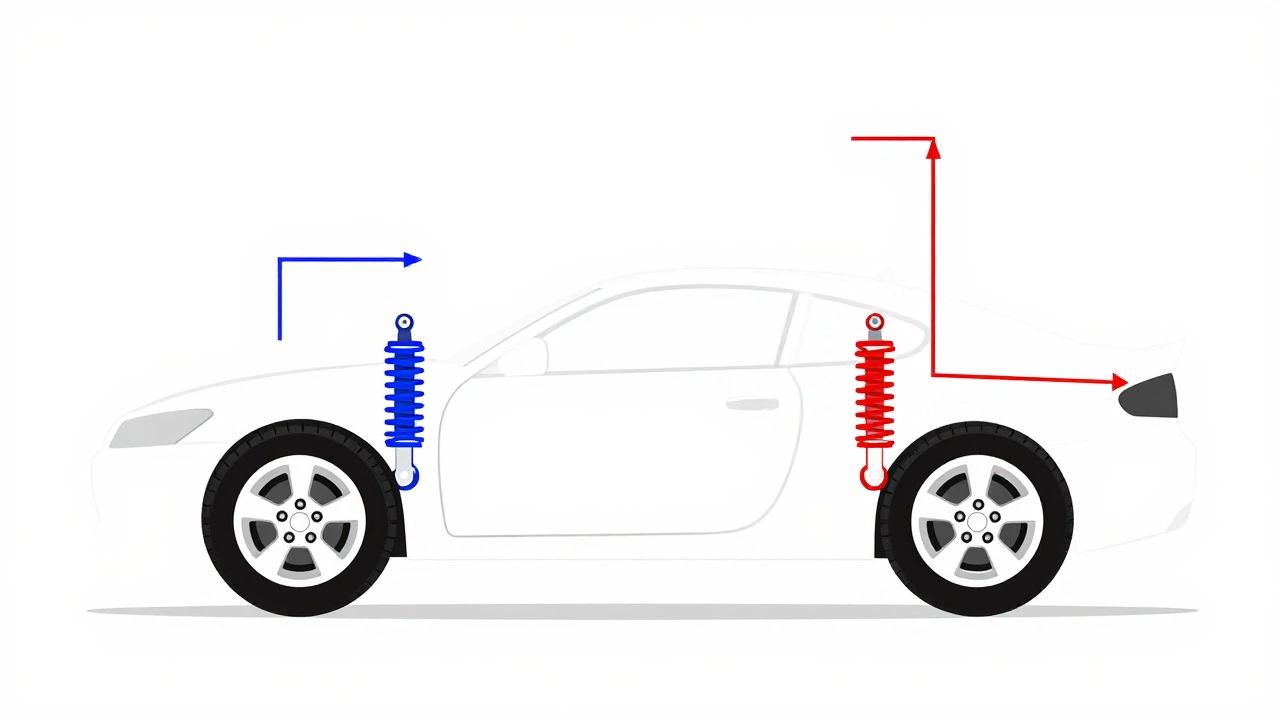
Here is a critical concept that many enthusiasts miss: shock absorbers (or dampers) do not support the weight of the car; the springs do. The shocks control the oscillation of the springs. Stock shocks are tuned specifically for the stock spring rate. When you install stiffer lowering springs, you put more load on the existing shocks.
If your shocks are old or worn, adding stiffer springs will make the ride feel bouncy and unsettled. The shock can't keep up with the faster movement of the stiffer spring. In some cases, the shock may fail prematurely due to the increased heat and pressure generated by the higher spring rates. For the best result, many experts recommend replacing the shocks along with the springs, or opting for a complete coilover system, which integrates both components.
Lowering Springs vs. Coilovers: Which Is Better?
If ride quality is your main concern, you need to compare lowering springs against coilovers. Lowering springs are a bolt-on replacement that usually requires reusing your factory struts and shocks. They are cheaper and easier to install. However, you have zero adjustability. You get the ride height and damping the manufacturer designed.
Coilovers, on the other hand, replace the entire strut assembly. High-quality coilovers allow you to adjust the preload (ride height) and often the rebound and compression damping. This tunability is key. A well-tuned coilover setup can actually provide a *smoother* ride than cheap lowering springs because the damping can be dialed in to absorb high-frequency vibrations better. Cheap coilovers, however, can be worse than lowering springs if the damping seals are poor.
How to Keep Your Ride Comfortable After Lowering
You don't have to sacrifice all comfort to get that lowered look. There are specific strategies to mitigate the harshness:
- Choose Mild Drops: Stick to a 1-inch to 1.5-inch drop. Most modern cars handle this range well without severe geometry issues or excessive stiffness.
- Invest in Quality Brands: Not all lowering springs are created equal. Brands like Eibach, H&R, and KW use progressive spring rates. A progressive spring starts soft for small bumps (comfort) and gets stiffer as it compresses further (handling). This offers the best of both worlds.
- Upgrade Your Tires: Tire pressure and sidewall stiffness play a huge role in ride quality. If you lower your car, ensure your tire pressures are correct. Over-inflated tires on a stiff suspension will feel like riding on bricks.
- Check Bushings: Factory rubber bushings can degrade over time. Replacing them with polyurethane bushings can improve handling but may also transmit more road noise. Consider hydraulic bushings if you want to maintain isolation.
Real-World Scenarios: What to Expect
Let’s talk about real life. If you live in Brisbane, where roads can be smooth in the suburbs but rugged in the hinterland, your choice matters. Driving a car with aggressive 2-inch lowering springs on city streets with potholes will be painful. Every crack in the asphalt becomes an event.
However, if you drive mostly on highways and well-maintained suburban roads, a mild set of progressive lowering springs will likely feel firmer but not uncomfortable. You’ll notice less body roll in corners, which makes the car feel more planted and secure. Many drivers find that once they adjust to the firmer feedback, they prefer it because it gives them more confidence in the vehicle's dynamics.
Also, consider the season. In areas with extreme temperature changes, rubber components harden in the cold, making the ride feel even stiffer. If you live in a climate with harsh winters, a very stiff suspension setup can become unbearable during freezing months.
Common Mistakes to Avoid
One major error is mixing brands. Don't put front springs from one brand and rear springs from another unless they are specifically designed to work together. Mismatched rates can cause the car to pitch excessively during braking and acceleration, leading to a nauseating ride.
Another mistake is ignoring alignment. After installing lowering springs, you must get a professional alignment. Incorrect camber can cause uneven tire wear, which leads to vibrations at highway speeds. These vibrations are often mistaken for suspension harshness. Fixing the alignment often resolves the "rough" feeling.
Will lowering springs damage my suspension?
Not necessarily, but it increases stress. Stiffer springs put more load on bushings, ball joints, and tie rods. If you lower your car significantly (more than 2 inches), you should inspect these components regularly. Using high-quality springs and keeping the drop moderate minimizes the risk of premature failure.
Can I put lowering springs on a car with bad shocks?
You can, but it’s not recommended. Worn shocks cannot control the oscillation of stiffer springs effectively. This leads to a bouncy, unstable ride and can cause the new springs to fatigue faster. Replace shocks if they are leaking or over five years old.
What is the difference between linear and progressive springs?
Linear springs have a constant stiffness throughout their travel. Progressive springs start soft and get stiffer as they compress. For street driving, progressive springs offer a better compromise between comfort over small bumps and support during cornering.
Do lowering springs improve fuel economy?
Slightly. By lowering the center of gravity and reducing aerodynamic drag under the car, you may see a minor improvement in fuel efficiency, typically around 1-3%. However, this is negligible compared to driving habits and tire pressure.
Is it worth getting an alignment after installing lowering springs?
Absolutely. Lowering changes the suspension geometry, particularly camber. Without an alignment, your tires will wear unevenly, and your steering may pull to one side. An alignment ensures safety, extends tire life, and improves ride quality.